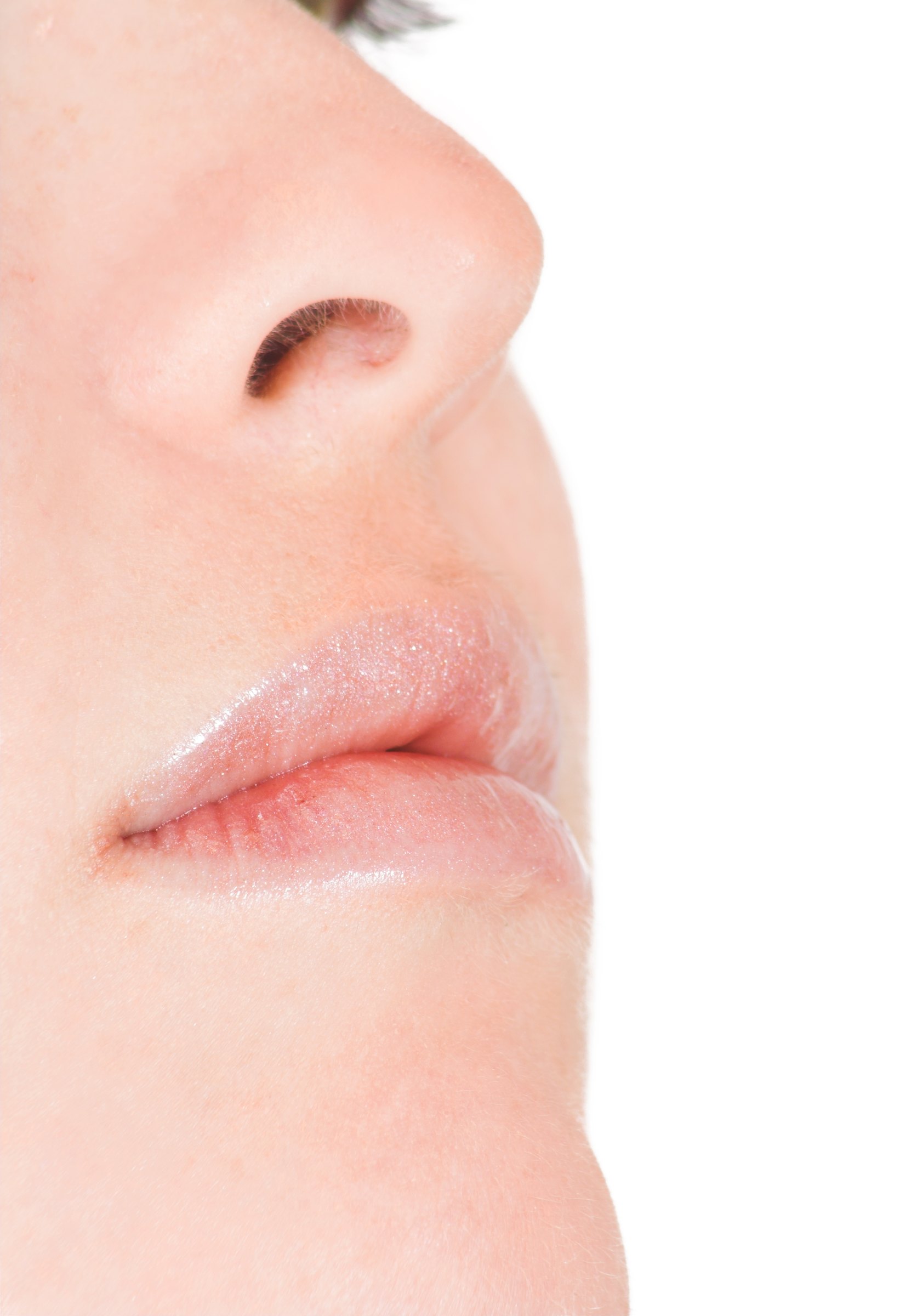
Most people arrive after a photograph from the side. Hyaluronic acid gel, placed against the chin bone, read in profile.
Book a consultationAsk about your profile
Chin filler adds forward projection to the lower face: hyaluronic acid gel placed against the chin bone. Juvéderm® Voluma® XC and Restylane® Defyne are FDA-approved for chin augmentation in adults over 21. Most patients need 1 to 2 syringes. Labeled studies followed patients to 12 months; in practice the result holds 12 to 18 months.
A better-balanced profile, or a lower face that reads longer. Both come from hyaluronic acid gel, cross-linked so it holds its shape for months. It can be dissolved with hyaluronidase; a genioplasty and a chin implant cannot.
What changes is the line of your profile. The gel goes deep, onto the periosteum, the membrane wrapping the chin, where it resists the pull of the mentalis muscle. It reads as bone. The two gels approved for the area differ in how they behave under that movement: Juvéderm® Voluma® XC is cross-linked with VYCROSS® technology and holds a firmer, more defined edge, while Restylane® Defyne is made with XpresHAn Technology™ and stays more flexible during speech.


| Product | Composition | FDA status for the chin | Typical duration | Handling behavior | Reversible |
|---|---|---|---|---|---|
| Juvéderm® Voluma® XC | Hyaluronic acid 20 mg/mL with 0.3% lidocaine, VYCROSS® cross-linking | Approved for chin augmentation to improve chin retrusion, adults over 21 | 12 months in the chin study; 12 to 18 months in practice | Firm and cohesive; holds a defined anterior point against bone | Yes, with hyaluronidase |
| Restylane® Defyne | Hyaluronic acid 20 mg/mL with 0.3% lidocaine, XpresHAn Technology™ | Approved for chin augmentation to correct retrogenia, adults over 21 | 12 months in the chin study; 12 to 18 months in practice | More flexible; moves with the mentalis during speech | Yes, with hyaluronidase |
The two FDA-approved chin fillers behave differently rather than one outperforming the other, and how much your chin moves is what decides between them. Neither one is the upgrade. Ranges come from product labeling and from practice observation.
Juvéderm® Voluma® XC — FDA-approved for chin augmentation to improve chin retrusion in adults over 21. Hyaluronic acid at 20 mg/mL with 0.3% lidocaine, cross-linked with VYCROSS® technology. Firm and cohesive, so it holds a defined anterior point against bone.
Restylane® Defyne — FDA-approved for chin augmentation to correct retrogenia in adults over 21, retrogenia being the term for a chin that sits behind the lower lip. Hyaluronic acid at 20 mg/mL with 0.3% lidocaine, made with XpresHAn Technology™. More flexible under animation, which suits a mobile lower face.
Hyaluronidase — Using hyaluronidase to dissolve cosmetic filler is an off-label use of an approved enzyme, and it is standard practice. A more heavily cross-linked gel sometimes needs more than one session. A vial is on site for every filler appointment, because a suspected vascular occlusion is treated within hours rather than days.
Photographed at fixed distance and angle. Then we read the profile together, chin against lower lip.
The gel, the syringe count and the cost are written down before anything is opened. Where chin filler is not indicated, the written plan names what is.
Topical anesthetic for 15 minutes. Gel placed deep at the periosteum, one or two entry points.
Ask about follow-up timing, contact arrangements, and any additional charges before treatment.

Assessment, photography and consent take most of it. Both gels carry 0.3% lidocaine, so the second pass is duller than the first.
Visible the same day. Give it two weeks. Swelling peaks at 24 to 48 hours and resolves by day seven. Labeled studies followed patients to 12 months; in practice the result holds 12 to 18 months. The chin holds longer than a lip, because it moves less.


Chin filler stings briefly at the entry point, then reads as pressure. Topical anesthetic sits for 15 minutes beforehand, and both Juvéderm® Voluma® XC and Restylane® Defyne contain 0.3% lidocaine. The injecting is over in a few minutes.
Most chin augmentations take 1 to 2 syringes. A modest increase comes from 1 mL; a short lower third takes 2 mL or more. The first visit starts low; gel can be added at two weeks.
Chin filler typically lasts 12 to 18 months in practice. The chin augmentation studies for Juvéderm® Voluma® XC and Restylane® Defyne followed patients to 12 months, which is where the labeled data stops. The chin holds filler longer than the lips, because hyaluronic acid breaks down faster in tissue that moves and the chin moves comparatively little.
Yes, and it is worth settling first. Both products are hyaluronic acid gels, and hyaluronidase dissolves them, usually within 24 to 48 hours, though a heavily cross-linked gel can need more than one session. Using hyaluronidase to dissolve cosmetic filler is an off-label use of an approved enzyme, and it is standard practice. A vial is on site for every filler appointment.
Chin filler at the front usually makes the lower face read longer and narrower, not bigger. Projection at the pogonion, the most forward point of the chin, lengthens the profile. Width added at the sides squares the lower face instead, which suits some anatomy and not others, and it sits outside the labeled chin-augmentation indication, so it is named as off-label before consent. You see which is proposed before anything opens.
No. Reversibility is most of the difference. A chin implant sits against bone in an operating room and stays until a surgeon removes it. Filler wears off over 12 to 18 months in practice, or is dissolved sooner.
No. Chin filler adds structure at the bone and does not remove fat under the jaw. The submental area can read tighter afterward, because a longer profile stretches the skin between chin and neck. The fat is unchanged.
The cost depends on your treatment plan. Call (614) 425-1633 for current pricing and ask what consultation, treatment, and follow-up charges apply.
The common risks are bruising, swelling, tenderness and temporary firmness, which usually settle within a week. Less common are asymmetry, palpable nodules, and delayed inflammatory nodules that appear months later. The rare and serious risk is vascular occlusion, where filler enters or compresses a vessel and the skin that vessel supplies loses its blood supply. Escalating pain, blanching, or dusky skin is an emergency and is treated as one, which is why hyaluronidase is kept in the room.
Yes, planned together: the chin is the front end of the jawline. Treated at once, the lower face often takes 3 to 5 syringes and swells for days. Placing the chin first shows what the jawline needs.

Chin filler results vary between patients. Nothing on this page is a promise of a specific result, and chin filler is not a treatment for a bite, airway, or joint problem.
Juvéderm®, Voluma® and VYCROSS® are trademarks of Allergan Aesthetics, an AbbVie company. Restylane®, Defyne and XpresHAn Technology™ are trademarks of Galderma. Rouge Aesthetics is not affiliated with or endorsed by either company.
This page is general information, not medical advice. Chin filler requires an in-person consultation and a medical eligibility review, and treatment is provided only where it is indicated.
Rouge Aesthetics · 101 Mill Street, Suite 210, Gahanna, OH 43230 · (614) 425-1633
Individual results vary. This website provides general information and does not replace an individual consultation.