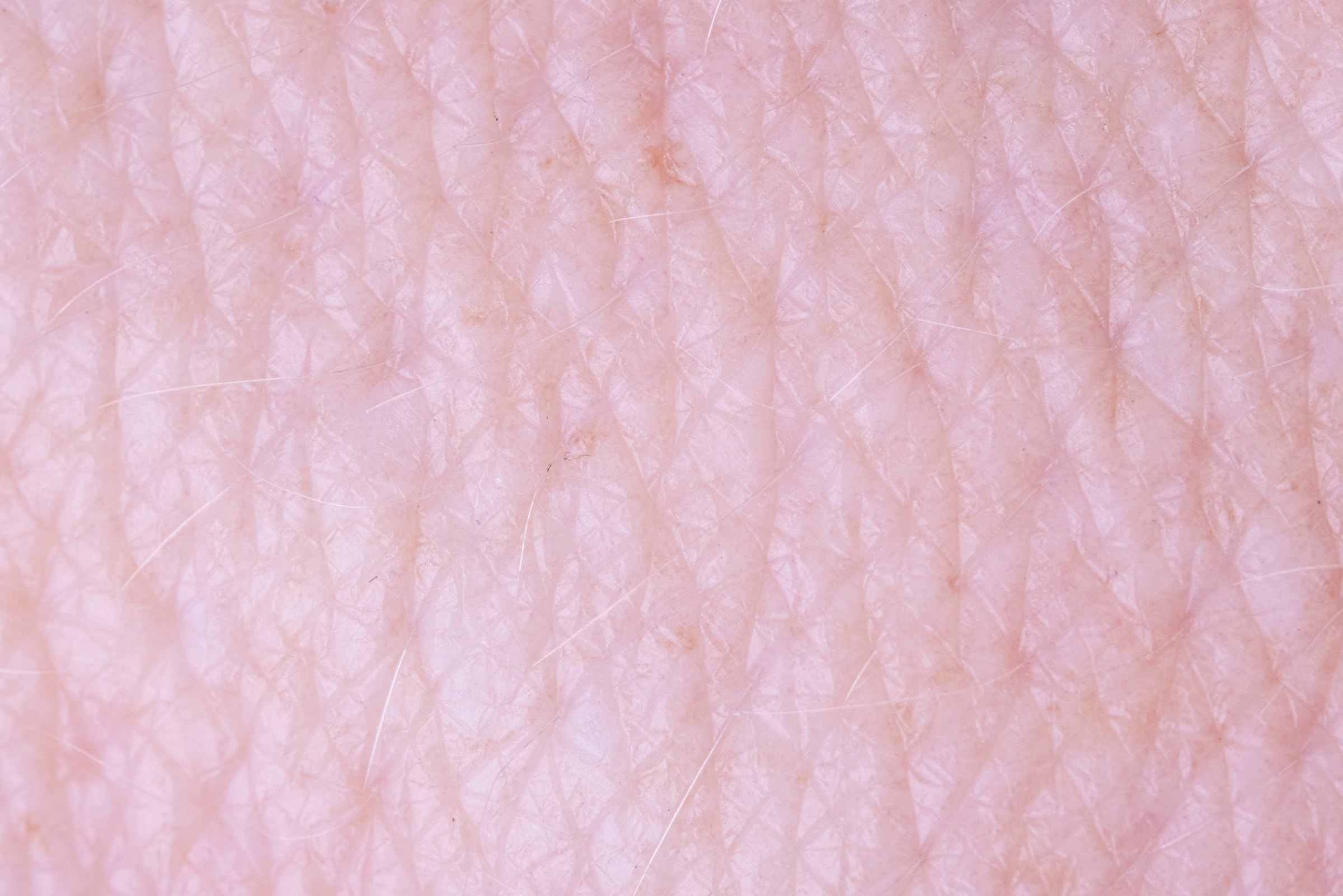
This works on texture, not shape. Needles reach a set depth in the dermis; repairing those channels lays down collagen.
Book a consultationHave your skin's texture read
Microneedling makes controlled micro-injuries in the dermis, so your skin repairs them with collagen. It works on texture, pores and acne scarring rather than volume. Most patients have 3 to 4 sessions about 4 weeks apart. Devices are FDA-cleared for facial acne scars in adults 22 and older; other uses are off-label.
Microneedling is collagen induction therapy, or percutaneous collagen induction: a pen drives needles into the dermis, 0.5 to 2.5 mm. Healing those channels is the treatment.
Each channel is a controlled injury, and the repair is the treatment. Nothing is added and nothing is filled.


| Treatment | How the collagen response is triggered | Typical series | Usual visible downtime | What it does not address |
|---|---|---|---|---|
| Microneedling | Sterile needles create controlled micro-injury in the dermis | 3 to 4 sessions, 4 weeks apart | 24 to 72 hours of redness | Volume loss, movement lines, significant laxity |
| PRF microneedling | The same passes, with the patient's own platelet-rich fibrin applied after | 3 to 4 sessions, 4 weeks apart | 2 to 4 days of redness and swelling | Volume loss and movement lines; no platelet preparation is FDA-cleared for this use |
| PRP microneedling | Needling paired with platelet-rich plasma rather than fibrin | 3 sessions, 4 to 6 weeks apart | 2 to 4 days | Volume loss and movement lines; no platelet preparation is FDA-cleared for this use |
| Sculptra® | Injected poly-L-lactic acid stimulates collagen at depth over months | About 3 sessions, 4 to 6 weeks apart | 1 to 3 days of swelling or bruising | Surface texture, pore appearance, superficial scarring |
| Home derma roller | Superficial epidermal disruption only | Not recommended | Variable | Dermal remodeling; carries infection and scarring risk when reused |
The question is whether the complaint sits in the surface or the volume beneath. Microneedling devices are FDA-cleared: 510(k) clearance from the U.S. Food and Drug Administration (FDA), which is not approval. Ranges reflect device labeling and treatment records at this practice, and individual results vary.
Motorized microneedling pen (FDA-cleared device) — Devices in this class are FDA-cleared for facial acne scars in adults aged 22 and older, and some are additionally cleared for neck wrinkles. Use elsewhere on the face and body is off-label.
Single-use sterile needle cartridge — Cartridges are never reused between patients or between areas. Single use is the infection-control basis of the treatment, since there is no reprocessing step that would make a used cartridge fit for a second patient.
Compounded topical anesthetic (lidocaine and tetracaine) — Applied to a defined surface area and timed. The FDA has warned that large-area, long-dwell compounded topical anesthetics carry a documented systemic toxicity risk, which is why the area and the clock are both limited.
Sterile injection-grade hyaluronic acid glide medium — Cosmetic serums, including most vitamin C formulations, are not manufactured for intradermal use and are not used here.
Post-procedure barrier ointment and mineral SPF 30 or higher — Skin healing from micro-injury pigments easily in response to UV, so daily mineral sunscreen is part of the post-procedure protocol rather than an optional extra.
Platelet-rich fibrin (optional add-on) — Centrifuge systems are cleared for preparing autologous blood products, but no platelet preparation is FDA-cleared or approved for aesthetic skin treatment. That makes it a provider-directed use of an unapproved preparation rather than an off-label use of an approved one. The published evidence is strongest in acne scarring and mixed elsewhere.

The scar type is identified under standard lighting. Rolling, boxcar and ice-pick scars respond differently.
Your face is photographed at fixed distance and lighting. Anesthetic sits 20 to 30 minutes.
Depth is set per region; passes continue until uniform redness.
Barrier product and written aftercare go home. The next session is 4 weeks out.

Topical anesthetic sits under occlusion 20 to 30 minutes; a full face takes another 20 to 30. You will leave red and warm.
Nothing useful shows for about four weeks. Your skin looks brighter after each session, then returns to baseline while remodeling carries on underneath.


Uncomfortable rather than painful, once the topical anesthetic has sat for 20 to 30 minutes. The eyelid skin inside the bony orbital rim is not treated at all, and the area immediately outside it is worked shallower. Say something and the depth is eased.
Most patients need 3 to 4 sessions spaced 4 weeks apart, and acne scarring often takes 5 to 6. The interval gives remodeling time to become readable. The series ends when your skin stops changing.
Expect 24 to 72 hours of redness, with swelling on day one and flaking on days three to five. Makeup goes back on at 24 hours. Plan five days before anything you cannot be pink for.
The distinction is worth having, because it tells you exactly what has been reviewed and what has not. Microneedling devices are FDA-cleared, not FDA-approved, which is the pathway used for devices rather than drugs and turns on showing that a device is equivalent to one already on the market. Cleared indications on devices in this class are narrow: facial acne scars in adults aged 22 and over, and on some devices neck wrinkles. Treating other areas and other concerns with the same device is off-label, meaning that particular use has not been through review; it is legal, common, and disclosed before consent. You will hear which category your own treatment falls into before you consent to it.
Microneedling improves acne scarring partially and does not clear it. Rolling and shallow boxcar scars respond best, because their sloped edges give remodeling something to work with. Ice-pick and tethered scars usually need subcision first.
A home roller does not reach the depth a medical device works at. A rolling needle enters and leaves on an arc, tearing the channel. Rollers are hard to sterilize and a documented cause of infection and scarring.
Sterile, injection-grade hyaluronic acid is the only glide medium used. Cosmetic serums, including vitamin C, are made for the surface rather than intradermal use, and have caused granulomatous reactions when needled in. Platelet-rich fibrin is the one add-on.
Yes, and the mechanism is the reason: microneedling is lower-risk than ablative lasers in Fitzpatrick skin types IV through VI, because it does not remove the epidermis with heat. Post-inflammatory hyperpigmentation is possible with aggressive depth or sun afterward, so depth is kept conservative.
Yes, though usually spaced rather than stacked on one day: the neuromodulator first, then microneedling one to two weeks later, so needling pressure is not applied over product still settling. Microneedling changes skin quality; onabotulinumtoxinA (Botox®) changes movement.
The cost depends on your treatment plan. Call (614) 425-1633 for current pricing and ask what consultation, treatment, and follow-up charges apply.
Microneedling devices are FDA-cleared, not FDA-approved. Clearance in this device class covers facial acne scars in adults aged 22 and older, and on some devices neck wrinkles. Treatment of other areas and other concerns is an off-label use, which is legal and common, and is disclosed before consent.
Individual results vary and no outcome is guaranteed. Nothing on this page is a promise of a specific result, and microneedling is not a cure for acne scarring. Improvement in scarring is typically partial.
This page is general information, not medical advice, and not a substitute for an in-person evaluation. Treatment requires a consultation and a medical eligibility review, and treatment is provided only where it is indicated.
Rouge Aesthetics · 101 Mill Street, Suite 210, Gahanna, OH 43230 · (614) 425-1633
Individual results vary. This website provides general information and does not replace an individual consultation.